
To appeal a denied claim, start with the remit. The reason and remark codes tell you whether the claim needs a correction or an appeal: billing errors are corrected and resubmitted, while decisions you disagree with, such as medical necessity, are appealed with evidence. For Original Medicare, the first appeal, a redetermination, is due within 120 days of receiving the initial determination. For commercial plans, your contract sets the provider appeal deadline.
A denial is a decision, and most decisions can be challenged. The work is knowing which ones are worth it, building the case, and getting it in on time. These 5 steps apply to any payer. The deadlines that follow are where Original Medicare and commercial plans part ways.
Step 1: decide whether to correct or appeal
Start with the codes on the remit, not the claim. Our guide to common denial codes explains what each one means.
- Correct it when the claim itself was wrong: a typo, a missing modifier, a wrong diagnosis pointer, or missing information such as CO-16. For most commercial payers that means a corrected claim, frequency code 7, that references the original claim number. For Original Medicare, a minor clerical error is fixed through a reopening (opens in a new tab) with your contractor, not an appeal.
- Appeal it when you disagree with the payer’s decision: medical necessity (CO-50), an authorization you did obtain (CO-197), a bundling edit on services that were truly distinct, or a timely filing denial when you can prove the claim went out on time.
- Let it go when the denial is correct and the claim cannot be fixed. Adjust it under your policy, and fix the process so it does not happen again.
Step 2: gather the evidence
An appeal is only as strong as what is attached to it. Pull together:
- The remit, with the reason and remark codes.
- The claim as it was sent, and the corrected version if anything changed.
- The clinical note, and any results that support the service.
- The authorization number and approval, if one applies.
- The payer policy or coverage rule you rely on, with the section named.
- Proof of timely filing, such as a clearinghouse acceptance report, for a CO-29 denial.
Step 3: write the appeal letter
Keep it short and specific. Reviewers read many of these, and the ones that win make the case in a few paragraphs. A good appeal letter includes:
- The patient’s name, member ID, claim number, date of service, and the codes billed.
- The denial you are appealing, with its reason and remark codes.
- Why the decision is wrong, in 2 or 3 sentences, tied to the payer’s own policy or your contract.
- A list of the documents enclosed.
- The name and contact details of the person handling the appeal.
Use the payer’s appeal form when it has one. For Original Medicare, a redetermination request (opens in a new tab) goes in writing, on form CMS-20027 or in a letter with the same information, to the contractor that made the initial decision.
Step 4: meet the deadline
Appeal deadlines are strict, and a late appeal is usually dismissed however good the case is. They differ by payer.
Original Medicare
Original Medicare has 5 levels of appeal (opens in a new tab). Each deadline counts from the day you receive the previous decision.
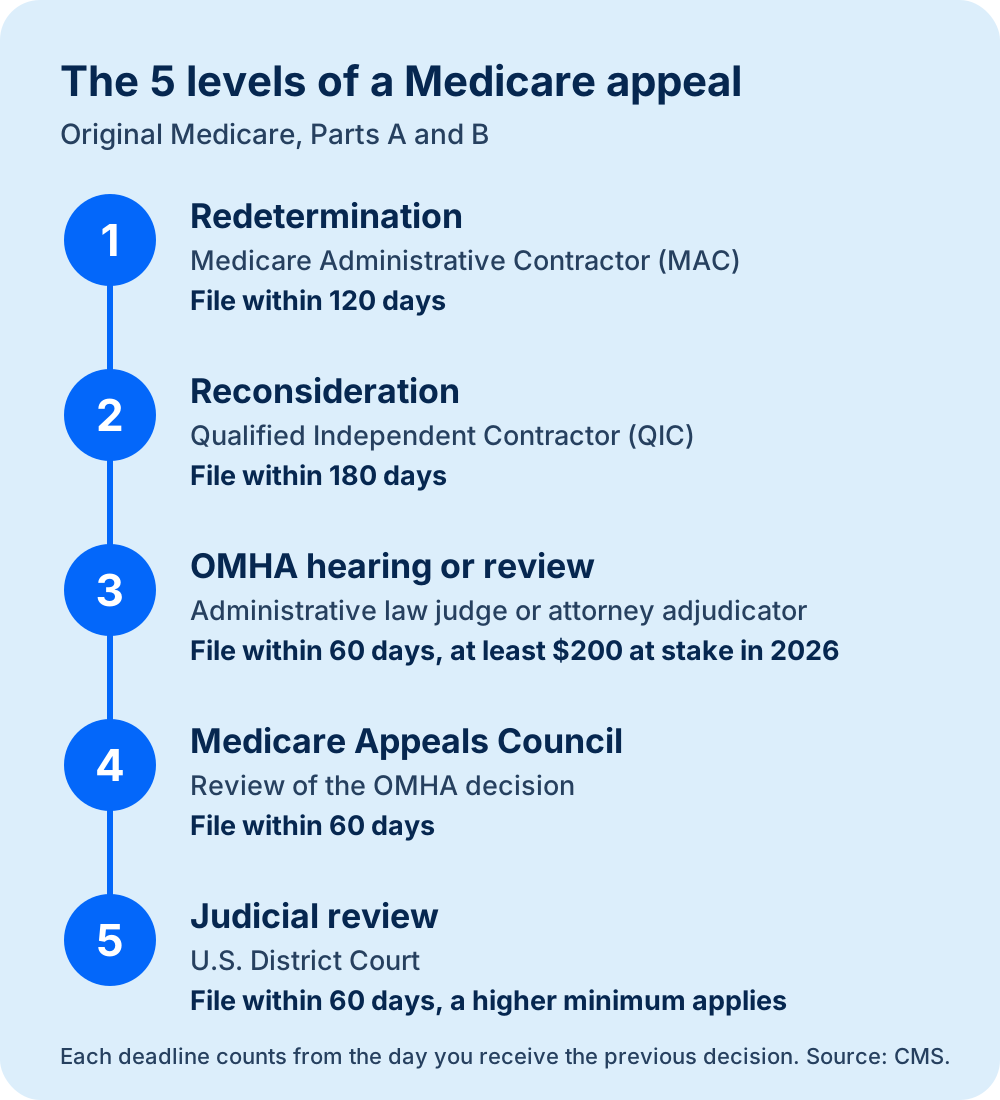
- Level 1, redetermination by your Medicare Administrative Contractor (MAC). File within 120 days of receiving the initial determination. The MAC generally decides within 60 days.
- Level 2, reconsideration by a Qualified Independent Contractor (QIC). File within 180 days of receiving the redetermination. The QIC generally decides within 60 days.
- Level 3, a hearing or review by the Office of Medicare Hearings and Appeals (OMHA). File within 60 days of receiving the reconsideration. In 2026, at least $200 has to remain in dispute (opens in a new tab).
- Level 4, Medicare Appeals Council review. File within 60 days of receiving the OMHA decision.
- Level 5, judicial review in federal district court. File within 60 days of receiving the Council’s decision, with a higher minimum amount in dispute.
Commercial and Medicare Advantage plans
For a commercial plan, your payer contract and provider manual set the provider appeal deadline, the number of appeal levels, and where to send them. Check them first, because they are often shorter than Medicare’s. Medicare Advantage plans run their own appeal process too, so check the plan’s provider manual rather than assuming Original Medicare’s.
A patient on an ACA-compliant plan can also appeal on their own behalf. According to HealthCare.gov (opens in a new tab), the patient must file an internal appeal within 180 days of receiving notice of the denial, and the plan must decide within 30 days for a service not yet received, or 60 days for one already received. If the plan still says no, the patient can usually ask for an independent external review.
Step 5: track it, and learn from it
Log every appeal with the date it was sent, its deadline, and the outcome. A payer that keeps upholding the same denial is telling you something about your claims or your contract. The overturned ones are telling you something too: if an appeal wins every time, the claim should have been right the first time, and the fix belongs in denial prevention, not in a better letter.
Where Heron fits
Heron works denials inside the appeal window. It names the root cause in plain language, drafts the appeal with the documentation attached, and follows it with the payer to a decision, while your billers keep final sign-off. Denial intelligence then shows which denials keep coming back, so the next fix happens before the claim goes out. For claims already close to a deadline, see aged A/R recovery.
Sources
- Original Medicare (Fee-for-service) Appeals, CMS (opens in a new tab)
- First Level of Appeal: Redetermination by a Medicare Contractor, CMS (opens in a new tab)
- Third Level of Appeal: Decision by the Office of Medicare Hearings and Appeals, CMS (opens in a new tab)
- MLN006562, Medicare Parts A and B Appeals Process, CMS (opens in a new tab)
- Medicare Claims Processing Manual, Chapter 34: Reopening and Revision of Claim Determinations, CMS (opens in a new tab)
- Internal appeals, HealthCare.gov (opens in a new tab)