
A denial code on a remit has 2 parts. The group code, such as CO or PR, says who is responsible for the amount, and the claim adjustment reason code says why it was not paid. Most denials at a practice trace back to a short list: missing information (CO-16), missing authorization (CO-197), medical necessity (CO-50), bundling (CO-97), eligibility (CO-27 and CO-31), and timely filing (CO-29). Each has a different fix, and many can be stopped before the claim goes out.
Payers report denials on the 835 electronic remittance advice, or ERA, using standard code lists that X12 maintains. The official lists are long and terse. This guide covers the codes practices run into most, grouped by the root cause behind them, so you can fix the claim in front of you and the process that produced it. In Experian Health’s 2026 State of Claims survey (opens in a new tab), providers named services not covered as the top reason for denials, followed by frequently changing payer policies, then coding errors and trouble getting prior authorization.
Jump to a group: eligibility and registration, authorization, coding and bundling, documentation and medical necessity, coverage and patient share, or filing deadlines and duplicates.
How to read a denial code
Take CO-197. The letters are the group code, and the number is the claim adjustment reason code, or CARC.
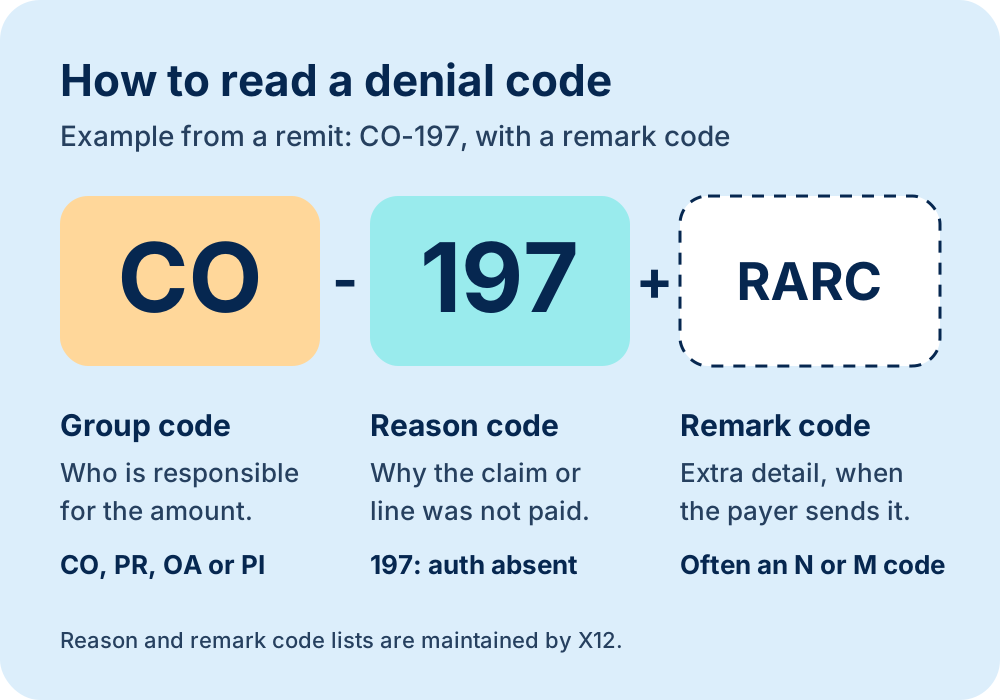
- CO, contractual obligation. The amount is the provider’s responsibility under the payer contract. You cannot bill the patient for it.
- PR, patient responsibility. The patient owes the amount, such as a deductible, coinsurance, or copay.
- OA, other adjustment. Used when neither CO nor PR fits, for example on an exact duplicate claim.
- PI, payer-initiated reduction. The payer says the patient is not responsible, but no contract between you and the payer backs the reduction.
Many denials also carry a remittance advice remark code, or RARC, such as an N or M code. The remark code often names the exact missing item, so read it before you touch the claim. X12 publishes both the claim adjustment reason codes (opens in a new tab) and the remark codes (opens in a new tab).
Eligibility and registration denials
These start at the front desk, which makes them some of the most preventable. Our page on insurance eligibility verification covers how Heron checks coverage before the visit.
CO-27: coverage ended before the service
- What it means. The payer says the patient’s coverage had ended by the date of service.
- Common causes. A job or plan change, a new plan year, or coverage checked once and never again.
- How to fix it. Run eligibility for the date of service, get the patient’s current insurance, and bill the right payer. If coverage was active, appeal with the eligibility response that proves it.
CO-31: patient cannot be identified as the payer’s member
- What it means. The payer cannot match the patient to anyone on its rolls.
- Common causes. A typo in the member ID, name, or date of birth, or the subscriber’s details entered in place of the patient’s.
- How to fix it. Compare the claim with the insurance card and the eligibility response, correct the details, and resubmit.
CO-22: another payer may be primary
- What it means. The payer believes another plan should pay first under coordination of benefits.
- Common causes. A second plan, a patient with both Medicare and a group plan, or an out-of-date coordination of benefits record at the payer.
- How to fix it. Confirm the order of benefits with the patient and both payers, bill the primary first, then send the secondary claim with the primary’s remit. If the payer’s record is wrong, the patient usually has to update it with the plan.
CO-109: claim sent to the wrong payer
- What it means. This payer or contractor does not cover the claim, and it has to go to the right one.
- Common causes. A Medicare Advantage patient billed to Original Medicare, or a plan whose claims go to a separate administrator.
- How to fix it. Find the correct payer on the card or in the eligibility response, and send the claim there inside that payer’s filing limit.
Authorization denials
These hit when a service needed approval first. Our guide to prior authorization covers the process in depth.
CO-197: authorization absent
- What it means. The service needed precertification, authorization, or notification, and the payer has none on file.
- Common causes. No authorization was requested, or the one on file covers a different code, date range, or provider, or it expired before the visit.
- How to fix it. If an authorization existed, appeal with its number and the approval. If not, ask whether the payer allows a retroactive authorization, which some do for a short window. Then add an authorization check to scheduling so it does not repeat.
Coding and bundling denials
These come from how the visit was coded. Many are caught by edits a claim scrubber runs before submission, which is the job of denial prevention.
CO-4: modifier does not fit the procedure
- What it means. The modifier billed is inconsistent with the procedure code. The remark code usually says which one.
- Common causes. A modifier applied out of habit, the wrong side of the body, or a modifier the payer does not accept for that code.
- How to fix it. Check the code and modifier against the payer’s policy and the note, correct the line, and send a corrected claim.
CO-11: diagnosis does not support the procedure
- What it means. The diagnosis codes on the claim are inconsistent with the procedure billed.
- Common causes. The supporting diagnosis was left off, the diagnosis pointer links the wrong code to the line, or the payer’s policy needs a more specific code.
- How to fix it. Check the documentation and the payer’s coverage policy, correct the diagnosis or the pointer, and resubmit.
CO-97: included in another service
- What it means. The payer considers the service part of another one it already paid, so it is bundled.
- Common causes. Bundling edits such as the National Correct Coding Initiative (NCCI) edits (opens in a new tab), or a service inside a global surgical period.
- How to fix it. If the services were truly separate, check whether modifier 59 or an X modifier (XE, XP, XS, XU) applies and the note supports it, then send a corrected claim. If not, the denial is correct, and the fix belongs in coding.
CO-236: procedure combination not allowed
- What it means. The procedures or modifiers billed for the same day are not compatible under NCCI or a state workers’ compensation fee schedule.
- Common causes. A code pair that NCCI does not allow together, billed without a modifier the edit accepts.
- How to fix it. Look up the pair in the NCCI tables, and only add a modifier when the documentation shows a distinct service.
CO-151: more services than the payer will support
- What it means. The payer says the information submitted does not support this many services, or this frequency.
- Common causes. Units above a payer limit, such as a Medicare medically unlikely edit (MUE) (opens in a new tab), or a service repeated sooner than the policy allows.
- How to fix it. Check the units against the payer’s limits and the note. If more services were medically necessary, appeal with the documentation.
Documentation and medical necessity denials
These turn on what the record shows. The fix is either missing paperwork or an argument, backed by the note, that the service met the payer’s policy.
CO-16: missing information or a billing error
- What it means. The claim lacks information or has a submission or billing error. X12 requires at least 1 remark code with it, and that code names what is missing.
- Common causes. A missing or invalid NPI, referring provider, date, place of service, or other required field.
- How to fix it. Read the remark code, add or correct the item, and send a corrected claim. CO-16 is usually fixed with a correction, not an appeal.
CO-50: not medically necessary
- What it means. The payer decided the service was not medically necessary under its policy.
- Common causes. A diagnosis outside the coverage policy, a note that does not document the symptoms or failed treatment the policy asks for, or a service the policy limits.
- How to fix it. Compare the note with the payer’s policy, such as a Medicare local coverage determination. If the record supports the service, appeal with the note and the criteria it meets. For Original Medicare patients, a valid Advance Beneficiary Notice signed before the service is what lets you bill the patient if Medicare denies.
CO-167: diagnosis not covered
- What it means. The payer does not cover the service for the diagnosis billed.
- Common causes. A diagnosis outside the policy for that service, or a less specific code than the documentation supports.
- How to fix it. Confirm the diagnosis is documented and coded as specifically as the record allows. If the policy truly excludes it, check your contract before billing the patient.
CO-252: documentation required
- What it means. The payer needs an attachment or other documentation to decide the claim, and the remark code says which.
- Common causes. An operative note, an invoice, or records the payer requires for that service.
- How to fix it. Send exactly what was requested, the way the payer asks for it, and track the request so it does not time out.
Coverage and patient share
Not every code on a remit is a denial. Some move the balance to the patient, and one is where underpayments hide.
CO-96: non-covered charge
- What it means. The payer does not cover the charge, and a remark code explains why.
- Common causes. A plan exclusion, a service not covered in that setting or for that provider type, or a benefit limit.
- How to fix it. Read the remark code and the patient’s benefits. If the payer applied the wrong rule, appeal. If the service is excluded, what happens next depends on your contract and any waiver the patient signed.
PR-204: not covered under the patient’s plan
- What it means. The patient’s current benefit plan does not cover the service, and the PR group code puts the amount on the patient.
- Common causes. A benefit the plan excludes.
- How to fix it. Confirm the exclusion in the benefits check, tell the patient before the visit when you can, and bill the patient under your financial policy.
PR-1, PR-2 and PR-3: deductible, coinsurance and copay
- What it means. These are not denials. They are the patient’s share: the deductible (PR-1), coinsurance (PR-2), or copay (PR-3).
- Common causes. The patient’s plan design.
- How to fix it. Post the amounts to the patient’s balance and bill the patient. Collecting the copay at check-in saves chasing it later.
CO-45: charge above the allowed amount
- What it means. The amount billed is above the payer’s allowable, and the difference is written off under your contract. It is usually not a denial.
- Common causes. Your charge master sits above your contracted rates, which is normal. The risk is a payer applying the wrong rate, because the shortfall then hides inside the CO-45 line and the claim closes at $0.
- How to fix it. Compare the allowed amount with your contracted rate. If it is lower, ask the payer to reprocess. Our page on underpayment recovery shows how Heron does this on every remit.
Filing deadlines and duplicates
These are about when and how the claim was sent, not what was on it.
CO-29: the filing deadline has passed
- What it means. The payer received the claim after its timely filing limit.
- Common causes. A claim stuck in a work queue, rejected by the clearinghouse and never resubmitted, or first sent to the wrong payer.
- How to fix it. Appeal only with proof of timely submission, such as a clearinghouse acceptance report dated inside the limit. Medicare’s limit is 12 months from the date of service, under the Medicare Claims Processing Manual (opens in a new tab). Commercial limits are set in your contract and are often shorter. Our page on aged A/R recovery covers working claims before they reach this point.
OA-18: exact duplicate claim
- What it means. The payer already has the same claim for the same service. X12 says to report it with group code OA, except where state workers’ compensation rules require CO.
- Common causes. A claim sent again while the first was still processing, or a correction sent as a new claim.
- How to fix it. Check the status of the original before sending anything. To change a processed claim, send a corrected claim, frequency code 7, that references the original claim number.
Where Heron fits
Heron reads every remit as it posts, groups denials by code, payer, and service line, and works each one the way this guide describes: corrections for the fixable ones, appeals with the evidence for the rest, and prevention for the patterns. Denial intelligence shows where your denials come from, and the steps in our guide to appealing a denied claim cover the ones worth fighting. A free audit of your last 90 days shows which codes cost you the most.
Sources
- Claim Adjustment Reason Codes, X12 (opens in a new tab)
- Remittance Advice Remark Codes, X12 (opens in a new tab)
- National Correct Coding Initiative (NCCI) edits, CMS (opens in a new tab)
- Medicare NCCI medically unlikely edits (MUEs), CMS (opens in a new tab)
- Medicare Claims Processing Manual, Chapter 1, CMS (opens in a new tab)
- Healthcare claim denial statistics: State of Claims Report 2026, Experian Health (opens in a new tab)